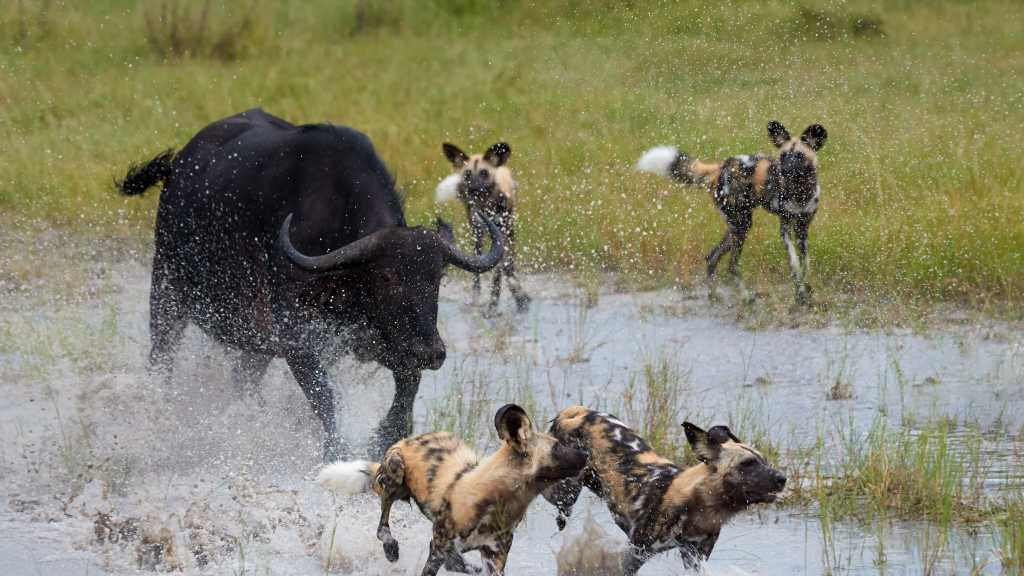
Located in the south-western part of Chobe National Park, Savuti is one of Botswana’s most iconic and untamed safari regions. Its character is shaped by the Savuti Channel, a watercourse that flows irregularly, creating a constantly changing environment of open grasslands, seasonal wetlands, and scattered woodland. This dynamic landscape supports an impressive concentration of wildlife. Savuti is particularly renowned for its lions—often seen during powerful hunting scenes—as well as hyenas, leopards, and large herds of elephants.
Reaching Savuti usually requires a 4x4 vehicle, though some camps can also be accessed by light aircraft depending on the season. The sandy tracks, vast horizons, and limited number of visitors create a strong feeling of remoteness and adventure. The area is also known for its rocky outcrops and ancient San rock art, adding a cultural and historical dimension to the safari experience and making Savuti one of the most immersive wilderness destinations in Botswana.
The Chobe National Park is one of Southern Africa’s most remarkable wildlife destinations, renowned for its extraordinary concentration of animals and its diverse landscapes. Located in northern Botswana near the borders of Namibia, Zambia and Zimbabwe, the park stretches from dense teak forests and open floodplains to the winding banks of the Chobe River, which forms the park’s lifeline.
Chobe is particularly famous for hosting one of the largest elephant populations in Africa. During the dry season, hundreds of these giants gather along the riverbanks to drink, bathe and play, creating unforgettable scenes for visitors. The park is also home to lions, leopards, buffalo, giraffes and numerous antelope species, while bird enthusiasts can spot hundreds of bird species throughout the year.
Game drives across the savannah reveal a constantly changing landscape, but one of Chobe’s most memorable experiences is a boat safari on the river. From the water, visitors can observe elephants swimming, hippos surfacing nearby and crocodiles basking along the banks. With its rich wildlife, striking scenery and unique river-based safaris, Chobe National Park offers an unforgettable immersion into Botswana’s untamed wilderness.
Botswana, the Greatest Wildlife
Botswana's National Parks are, without doubt, the wildest in Africa. Tourism is intentionally limited to preserve pristine nature. If you can afford authentic Africa, head for Botswana, one of the last wild sanctuaries on the continent, distinguished by an abundance of exceptionally rich wildlife. A trip to Botswana almost inevitably involves a visit to Victoria Falls in Zimbabwean territory due to their strategic position: take a step at the end of your safari, their grandiose appearance will amaze you.
When to go?
The dry season lasts from April to October to the south and November to the north where, however, the rain totals are higher. The southern part of the country is most exposed to cold winds during the winter period (early May to late August) when the average temperature is about 14 ° C (57.2 ° F). The whole country has hot summers with average temperatures around 26 ° C (78.8 ° F). Temperatures are high throughout the year although winter is the sunniest period. The whole country is windy and dusty during the dry season.
Formalities
The visa is not compulsory for French nationals. The passport must be valid for at least six months after entry into Botswana. The permitted length of stay is in the sole discretion of the Immigration officer, it is recommended to check the date on the stamp when entering the country.
Anyone traveling to Botswana with a minor child must be able to provide a complete and certified copy of the child's birth certificate or a plurilingual birth certificate in addition to his or her valid passport. If the child is traveling with only one of his parents, he will have to present a travel authorization signed by the absent parent.
Health
No vaccination is mandatory but some vaccinations are recommended; Yellow fever vaccination is mandatory for all travellers from a country where endemic yellow fever is present but may be advised to all travellers.
Antimalarial treatment is recommended (see your doctor).
Currency
The Pula (which in Tswana means "rain") is the official currency of Botswana.
Major credit cards are accepted in most of lodges but it is imperative to possess US dollars in sufficient quantity to regulate the extras (drinks, tips...)
SOUTH AFRICA NAMIBIA BOTSWANA ZIMBABWE ZAMBIA KENYA TANZANIA MOZAMBIQUE MAURITIUS REUNION