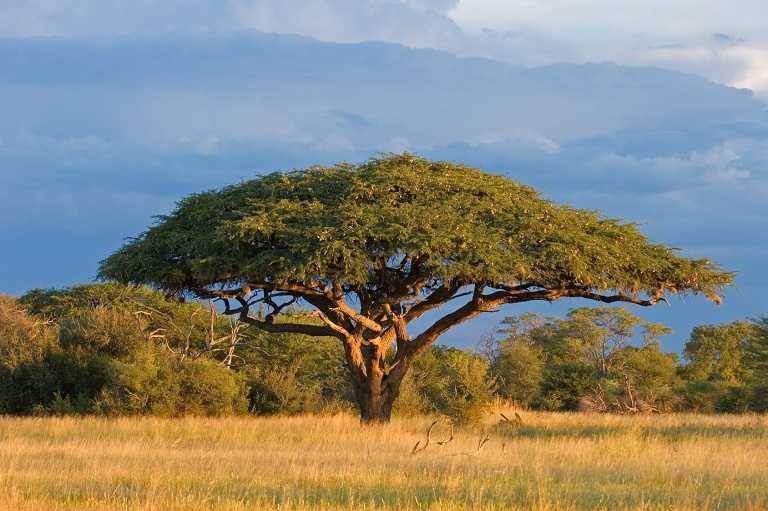
Covering more than 14,000 km2, Hwange National Park, created for the preservation of wildlife in its natural environment, is considered one of the protected areas with the greatest variety and density of animals in the world.
It is crisscrossed with 500 km of roads and tracks, offering an exclusive approach to African fauna and flora. It is famous for its high concentration of elephants and is home to an extremely varied fauna: 107 varieties of mammals have been identified in the park among which the ten protected species of Zimbabwe (white and black rhinos, brown hyenas, cheetahs, manna antelopes, oryx, aardwolf, wild dogs, proteles). 500 species of birds are also listed including different varieties of rollers, hornbills and raptors and rarer species such as the bustard (the largest bird in Africa after the ostrich).
The safaris organized by the various lodges are conducted by 4x4 vehicle and on foot.
Northern Zimbabwe is a land of striking contrasts, where raw wilderness blends seamlessly with some of Africa’s most iconic natural wonders. At its heart lie the legendary Victoria Falls, one of the largest and most awe-inspiring waterfalls on Earth.
Beyond the Falls, the region unfolds into vast protected landscapes such as Zambezi National Park and the renowned Hwange National Park, home to one of the largest elephant populations in Africa. Game drives, sunset cruises along the Zambezi River, and immersive safari experiences define the rhythm of travel here.
Both adventurous and serene, Northern Zimbabwe offers a perfect balance between thrilling encounters and peaceful moments in nature. It’s a destination that captures the true spirit of wild Africa.
Combining African landscapes, Zimbabwe will seduce you with its diversity. From the splendid Victoria Falls to the unforgettable sunsets of Lake Kariba, from the wild beauty of Mana Pools to the Hwange Park bush, you can experience canoe, motorboat, 4x4 vehicle and walking safaris in search of abundant wildlife. While 13% of its territory is devoted to reserves and other natural parks, it also houses the remains of the largest ancient capital of sub-Saharan Africa, the Great Zimbabwe.
When to go?
Zimbabwe has a tropical climate tempered by altitude, with a rainy season extending from late October to March. As it is located on highlands, it enjoys an average annual temperature of 25 ° C, relatively low compared to its neighbours in Southern Africa.
The country can be visited all year round with more favourable periods depending on interests:
- From May to October (winter): dry season will allow you to see animals as they stay nearby waterhole.
- From November to April, landscapes are green and lush
Formalities:
For French nationals: passport valid at least 6 months after the date of return. An entry visa is required. It can be issued either at the Zimbabwean Embassy in Paris or at points of entry into the territory (Harare and Victoria Falls airports in particular). Provision should be made for the exact amount in banknotes in the event of payment at the airport.
Health:
Anti-malarial treatment is recommended (see your doctor). No vaccinations are required for entry into Zimbabwe. However, it is advisable to check the updating of your usual reminders and vaccinations as for any country.
Other recommended vaccinations (depending on the duration, frequency and hygienic conditions of the stay): diphtheria-tetanus-polio (DTP) including Rubella Mumps and Measles in children; Anti-tuberculosis vaccination and bacterial meningitis A + C + Y + W135.
Currency
The Zimbabwe dollar was the official currency of Zimbabwe from 1980 to 2009. In April 2009, the government decided to leave out, initially for at least one year, the Zimbabwean dollar in favour of foreign currencies. At the beginning of 2015, the Zimbabwean dollar is still not used, in favour of multiple currencies, mainly the US dollar and the South African rand. From 2014, Zimbabwe even hits US dollar coins (only valid in Zimbabwe). Then in November 2016, new Zimbabwe dollar banknotes, indexed to the US dollar, are issued.
Important to know
Travellers' attention is drawn to liquidity issues:
- The maximum amount of foreign currency authorized on entry and exit is 1000 euros or 1,000 US dollars (USD) or 20,000 South African rand
- Cash withdrawals are irregular and limited to USD 100 per day and USD 300 per week
- Payment by bank card is not common.
The government put into circulation at the end of November 2016 two-note bonds with a par value of US $ 2 and US $ 5. These tickets are not convertible and it is advisable to spend them on the spot before the end of the stay
SOUTH AFRICA NAMIBIA BOTSWANA ZIMBABWE ZAMBIA KENYA TANZANIA MOZAMBIQUE MAURITIUS REUNION