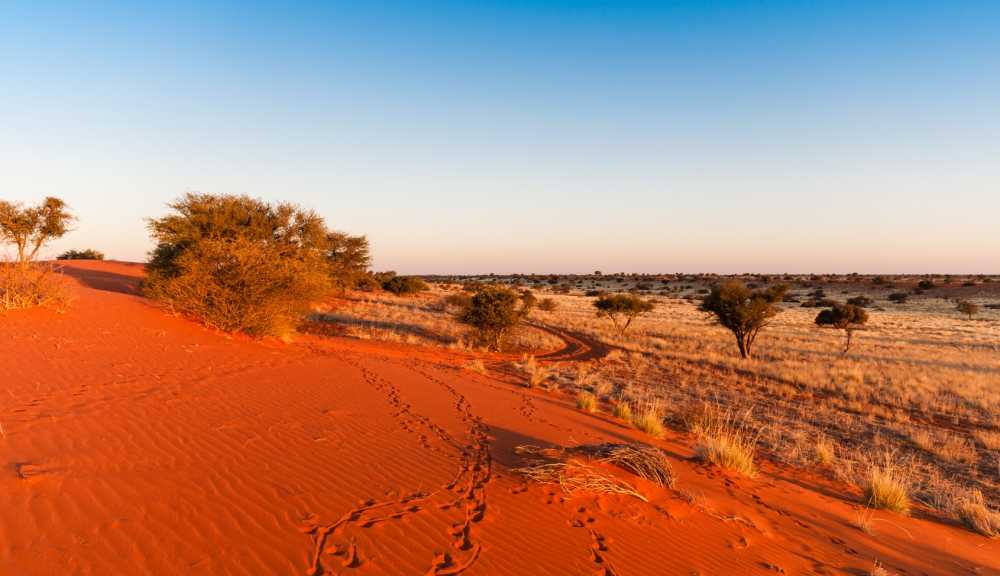
The Kalahari Desert stretches across three countries: South Africa, Botswana, and Namibia. In the south, two separate parks – the Gemsbok National Park in South Africa and its counterpart in Botswana – were united in 1999 through a cross-border treaty, giving rise to the Kgalagadi Transfrontier Park.
Covering 3.6 million hectares, the park offers a unique landscape composed mainly of red sand dunes interspersed with sparse bushes. Its name, derived from the Tswana word “kgala,” means “great thirst,” reflecting the extreme conditions that dominate the region.
Despite this arid climate, astonishing wildlife has adapted here. The park is home to the famous black-maned lions, cheetahs, leopards, and wild dogs, as well as hyenas, gnus, and several antelope species, including the gemsbok (oryx) and springbok. Birds are also abundant, with over 200 species recorded, including majestic vultures. Among the park’s most fascinating inhabitants, meerkats – called “meerkats” in Afrikaans – live in organized clans within underground burrows. The park also remains a refuge for the Bushmen, the indigenous people of the Kalahari.
To fully explore the park and enjoy its spectacular landscapes, it is recommended to use a 4x4 or a high-clearance vehicle. The sometimes sandy tracks and vast open spaces make each safari a unique adventure in one of Africa’s most iconic deserts.
The Northern Cape is the largest and the least populated province in South Africa, characterised by a cloudless sky and infinite landscapes. It borders in the west the cold waters of the Atlantic. It includes mainly dry and arid areas, as well as desert areas – including Kalahari, Namaqualand and Richtersveld –, dotted with rocky promontories. Seasonal contrasts here give sizzling summers and cold winters.
Advice:
- The best period to visit the Kgalagadi Transfrontier Park extends from April to October (winter) to avoid the hot weather. The area shows a significant temperature difference between day and night, in June and July
- The Kgalagadi Transfrontier Park combines with the Augrabies Falls and can be a small trip in its own. But can be very well combined with a trip to Namibia (Fish River Canyon and Kalahari).
- Do not miss the Namaqualand during the flower season mid August to September)!
South Africa, the 'rainbow' nation.
South Africa is so diverse you feel like you are visiting several countries in one trip!
With grandiose and various landscapes (mountains, « bush », beaches, forests, plains, desert), a pleasant climate in all seasons, an abundant and diversified fauna and flora including the “Big Five”, a population with the most composite ethnic groups, South Africa accumulates important natural wealth. Also note among its assets: quality of the hotel sector, services, road network, means of transport, rich and varied gastronomy, excellent wines, favourable exchange rates, 21 national parks and many private reserves, a multitude of activity throughout the country…
When to go?
South Africa has this peculiarity of presenting a wide variety of climates: Mediterranean, subtropical or temperate depending on the region with a high rate of sunshine everywhere (watch out for sunburn!)
South Africa can be visited all year round with more favourable periods depending on interests:
-
June, July and August (South African winter) for animals and therefore preferably the North of the country.
-
September and October: best times for flowers (Namaqualand) but very good for game drives as well.
-
From November to March (South African summer): best time to enjoy the South and East of the country, beaches of the Cape and the Indian Ocean. The Garden Route is particularly appreciated in February: the weather is nice; the temperature of the water is pleasant.
-
April and May: very pleasant autumn with always nice days in Cape Town and the resumption of the animal season.
Formalities:
The passport must include two blank pages and still be valid for 30 days after the expected date of exit from South Africa.
French nationals are exempted from prior visas. A 90-day residence permit will be issued at the border on entry into South African territory.
For other nationalities, inquire on a case-by-case basis with the competent authorities of their country of origin.
For any minor child: a multilingual extract of birth certificate (or an unabridged birth certificate translated into English - certified translation) is required to enter and leave South Africa (in the case of a child traveling with his 2 parents). Please consult the official sites for more information about all the requested documents according to your case.
Health:
No vaccinations are required for entry into South Africa. However, it is advisable to check the updating of your usual reminders and vaccinations as for any country.
Anti-malarial treatment is recommended (see your doctor).
Currency:
The Rand is the official currency of South Africa (symbol: ZAR). Credit cards are accepted everywhere and distributors are easily available for cash withdrawal. Travellers’ checks in euros are also accepted in banks and some hotels.
SOUTH AFRICA NAMIBIA BOTSWANA ZIMBABWE ZAMBIA KENYA TANZANIA MOZAMBIQUE MAURITIUS REUNION