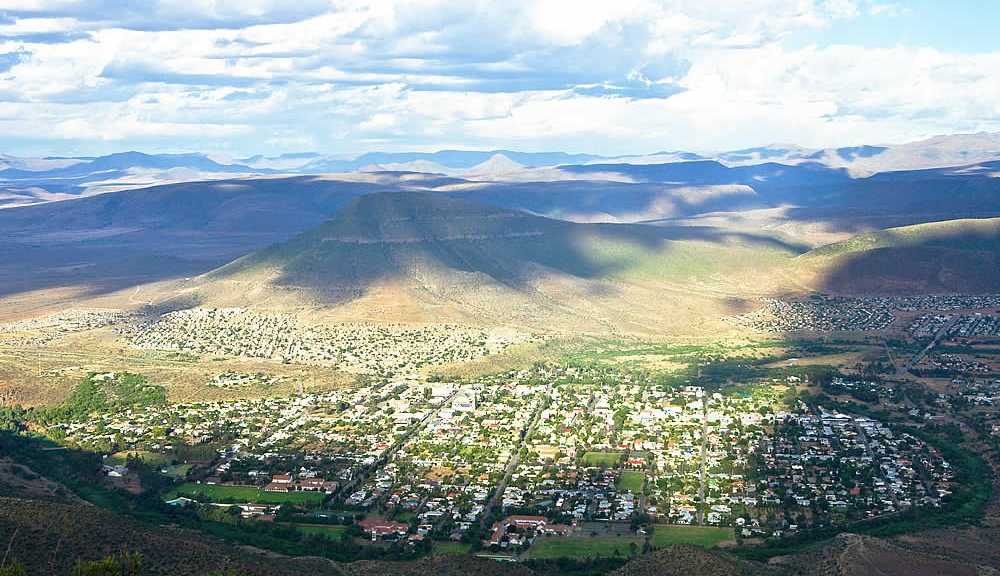
Graaff-Reinet, located in the heart of the semi-arid Karoo region, is a town that is undeniably worth a detour. Nicknamed the “Gem of the Karoo,” it is the fourth oldest town in South Africa and one of the most charming, with a rich and well-preserved historical heritage. Bordered by the Sundays River and overlooked by the Sneeuberg Mountains, it lies at the foot of Camdeboo National Park, offering a spectacular natural setting.
The town is a true open-air museum of the 19th century: since restoration began in 1952, more than 200 buildings classified as national monuments have been preserved, most of them privately owned. The best way to discover Graaff-Reinet’s richness is on foot, admiring its typical façades, historic churches, and picturesque squares.
Camdeboo National Park, which surrounds the town, invites visitors to explore the nature and wildlife of the Karoo. Here, you can see buffalo, elands, springboks, gemsboks, as well as more elusive mammals like the black-backed jackal, and a multitude of bird species. The park also features the Nqweba Dam, where fishing and water sports can be enjoyed in a peaceful, preserved setting.
The Valley of Desolation is undoubtedly the jewel of Camdeboo National Park. Its towering dolerite columns, some reaching 120 metres high, rise above the vast Karoo plains and offer breathtaking panoramas. Formed by volcanic and erosive forces over nearly 200 million years, these rock formations give the area a dramatic and almost otherworldly atmosphere. Each viewpoint in the valley reveals a different perspective, and the site is particularly spectacular at sunrise and sunset.
With its historical heritage, grand landscapes, and exceptional wildlife, Graaff-Reinet and Camdeboo National Park, along with the Valley of Desolation, offer a full immersion into the wild and fascinating heart of the South African Karoo.
Bordered by the Indian Ocean, Eastern Cape, which extends from the snow-capped peaks of the southern Drakensberg to the lush forest of the Tsitsikamma on the Garden Route, is unsurprisingly considered a land of extremes. Its natural diversity remains unmatched and also has 820 kilometers of wild coastline (Wild Coast). The province is steeped in culture and history: the Xhosa warriors, the Boers and the first British settlers fought each other there, later this province where Nelson Mandela was born, supported the fight for democracy in South Africa, but could not prevent the "creation" of 2 Bantustans under the apartheid regime (ghetto for the black population).
Advice:
- If you have a wild spirit, you will not miss the trails and beaches of the Wild Coast but you should keep in mind that this area really deserves its name of Wild Coast: you need to stay at least a week to soak up its special atmosphere
- The sunset at Cambedoo National Park with the city of Graaf-Reinet below is a unique experience!!! To do absolutely in good company!
- The Garden Route is beautiful all year round but if you choose to go the month of February, not only the weather and the heat are still almost guaranteed but you can enjoy even better as peak season (its flow of tourists and its high prices) is now over ...
South Africa, the 'rainbow' nation.
South Africa is so diverse you feel like you are visiting several countries in one trip!
With grandiose and various landscapes (mountains, « bush », beaches, forests, plains, desert), a pleasant climate in all seasons, an abundant and diversified fauna and flora including the “Big Five”, a population with the most composite ethnic groups, South Africa accumulates important natural wealth. Also note among its assets: quality of the hotel sector, services, road network, means of transport, rich and varied gastronomy, excellent wines, favourable exchange rates, 21 national parks and many private reserves, a multitude of activity throughout the country…
When to go?
South Africa has this peculiarity of presenting a wide variety of climates: Mediterranean, subtropical or temperate depending on the region with a high rate of sunshine everywhere (watch out for sunburn!)
South Africa can be visited all year round with more favourable periods depending on interests:
-
June, July and August (South African winter) for animals and therefore preferably the North of the country.
-
September and October: best times for flowers (Namaqualand) but very good for game drives as well.
-
From November to March (South African summer): best time to enjoy the South and East of the country, beaches of the Cape and the Indian Ocean. The Garden Route is particularly appreciated in February: the weather is nice; the temperature of the water is pleasant.
-
April and May: very pleasant autumn with always nice days in Cape Town and the resumption of the animal season.
Formalities:
The passport must include two blank pages and still be valid for 30 days after the expected date of exit from South Africa.
French nationals are exempted from prior visas. A 90-day residence permit will be issued at the border on entry into South African territory.
For other nationalities, inquire on a case-by-case basis with the competent authorities of their country of origin.
For any minor child: a multilingual extract of birth certificate (or an unabridged birth certificate translated into English - certified translation) is required to enter and leave South Africa (in the case of a child traveling with his 2 parents). Please consult the official sites for more information about all the requested documents according to your case.
Health:
No vaccinations are required for entry into South Africa. However, it is advisable to check the updating of your usual reminders and vaccinations as for any country.
Anti-malarial treatment is recommended (see your doctor).
Currency:
The Rand is the official currency of South Africa (symbol: ZAR). Credit cards are accepted everywhere and distributors are easily available for cash withdrawal. Travellers’ checks in euros are also accepted in banks and some hotels.
SOUTH AFRICA NAMIBIA BOTSWANA ZIMBABWE ZAMBIA KENYA TANZANIA MOZAMBIQUE MAURITIUS REUNION