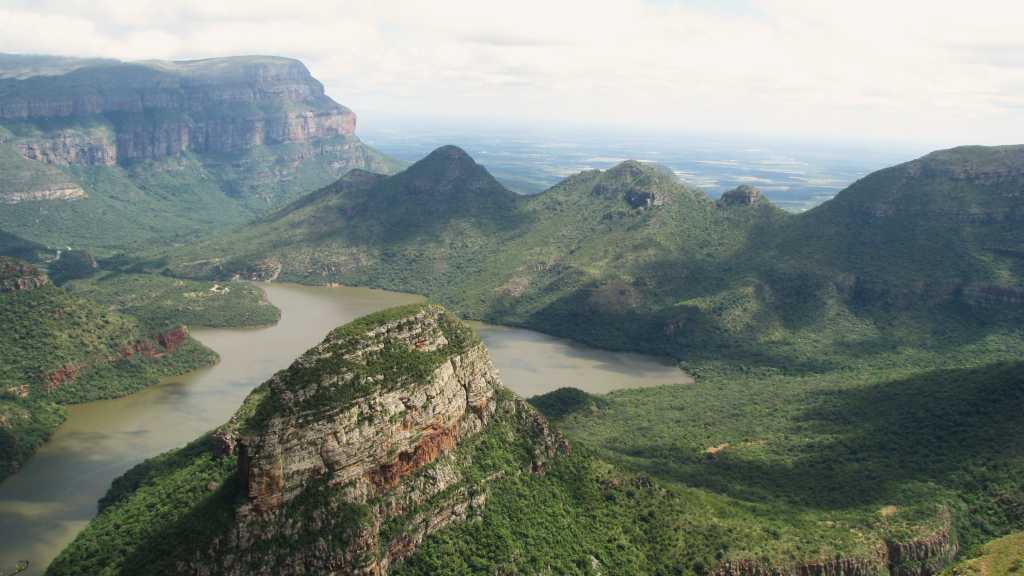
The Blyde River Canyon is one of the largest green canyons in the world and a true natural gem of South Africa. Its spectacular landscapes are dominated by the famous Three Rondavels, three tower-shaped rock peaks. Nearby, the Bourke’s Luck Potholes offer a fascinating geological spectacle: massive potholes carved by water over centuries. Along the canyon’s banks, several viewpoints allow visitors to admire the Blyde River winding 800 metres below, surrounded by cliffs and lush vegetation.
The region is traversed by the famous Panorama Route, a scenic drive offering some of the most impressive landscapes of Mpumalanga. The route connects Kruger National Park to the foothills of the Drakensberg, separating the South African highlands from the savannah that stretches to the Indian Ocean. Within just a few kilometres, the contrasts are striking: eucalyptus and pine forests, tropical fruit plantations, and deep valleys. The R40, between White River and Hazyview, perfectly illustrates this landscape diversity.
The Panorama Route is also famous for its spectacular waterfalls. Around Graskop, visitors can see the Berlin Falls, Lisbon Falls, Mac Mac Falls, and Maria Shire Falls.
Nearby, the historic village of Pilgrim’s Rest, South Africa’s first mining town, allows visitors to relive the gold rush era. Transformed into a museum town and classified as a national monument, Pilgrim’s Rest has preserved its buildings and streets almost intact, making it a must-visit stop for history enthusiasts and lovers of local culture.
Mpumalanga is the region that connects Johannesburg to the famous Kruger National Park. Mpumalanga means "place where the sun rises". Although it is one of the smallest provinces in South Africa, its spectacular natural diversity largely outweighs its size.
Not only Mpumalanga is home to the most famous natural park, the third deepest canyon and the oldest cave system in the world, but it is also dotted with nature reserves teeming with fauna and flora.
Advice:
- With the province bordering Kruger Park, there is an excellent choice of lodges and activities on the edge of the GRAND PARK.
- From January to March, the Drakensberg Escarpment allows to escape the summer heat of the lowveld.
- Dullstroom is accessible for a weekend from Johannesburg: Notice to trout fishing fans! The non-fishers can practice horse riding and other adventure sports… Be careful, the weather is cool, it’s one of the coldest areas of the country.
- Do not miss the Canyon on your rush to the Kruger, you will regret it! Scenic drives around the town of Sabie and the village of Pilgrim’s Rest give a great overview…
South Africa, the 'rainbow' nation.
South Africa is so diverse you feel like you are visiting several countries in one trip!
With grandiose and various landscapes (mountains, « bush », beaches, forests, plains, desert), a pleasant climate in all seasons, an abundant and diversified fauna and flora including the “Big Five”, a population with the most composite ethnic groups, South Africa accumulates important natural wealth. Also note among its assets: quality of the hotel sector, services, road network, means of transport, rich and varied gastronomy, excellent wines, favourable exchange rates, 21 national parks and many private reserves, a multitude of activity throughout the country…
When to go?
South Africa has this peculiarity of presenting a wide variety of climates: Mediterranean, subtropical or temperate depending on the region with a high rate of sunshine everywhere (watch out for sunburn!)
South Africa can be visited all year round with more favourable periods depending on interests:
-
June, July and August (South African winter) for animals and therefore preferably the North of the country.
-
September and October: best times for flowers (Namaqualand) but very good for game drives as well.
-
From November to March (South African summer): best time to enjoy the South and East of the country, beaches of the Cape and the Indian Ocean. The Garden Route is particularly appreciated in February: the weather is nice; the temperature of the water is pleasant.
-
April and May: very pleasant autumn with always nice days in Cape Town and the resumption of the animal season.
Formalities:
The passport must include two blank pages and still be valid for 30 days after the expected date of exit from South Africa.
French nationals are exempted from prior visas. A 90-day residence permit will be issued at the border on entry into South African territory.
For other nationalities, inquire on a case-by-case basis with the competent authorities of their country of origin.
For any minor child: a multilingual extract of birth certificate (or an unabridged birth certificate translated into English - certified translation) is required to enter and leave South Africa (in the case of a child traveling with his 2 parents). Please consult the official sites for more information about all the requested documents according to your case.
Health:
No vaccinations are required for entry into South Africa. However, it is advisable to check the updating of your usual reminders and vaccinations as for any country.
Anti-malarial treatment is recommended (see your doctor).
Currency:
The Rand is the official currency of South Africa (symbol: ZAR). Credit cards are accepted everywhere and distributors are easily available for cash withdrawal. Travellers’ checks in euros are also accepted in banks and some hotels.
SOUTH AFRICA NAMIBIA BOTSWANA ZIMBABWE ZAMBIA KENYA TANZANIA MOZAMBIQUE MAURITIUS REUNION